
Asteroid mining
The timeline, challenges, numbers, ecological impact, best and worst case scenarios

Imagine a future where trillion-dollar space rocks are routinely harvested, fueling Earth's industries and paving the way for interstellar expansion. Sound like science fiction? Maybe for now—but asteroid mining is inching closer to reality, with experts predicting that within a few decades, space prospectors might be striking it rich beyond our wildest dreams.
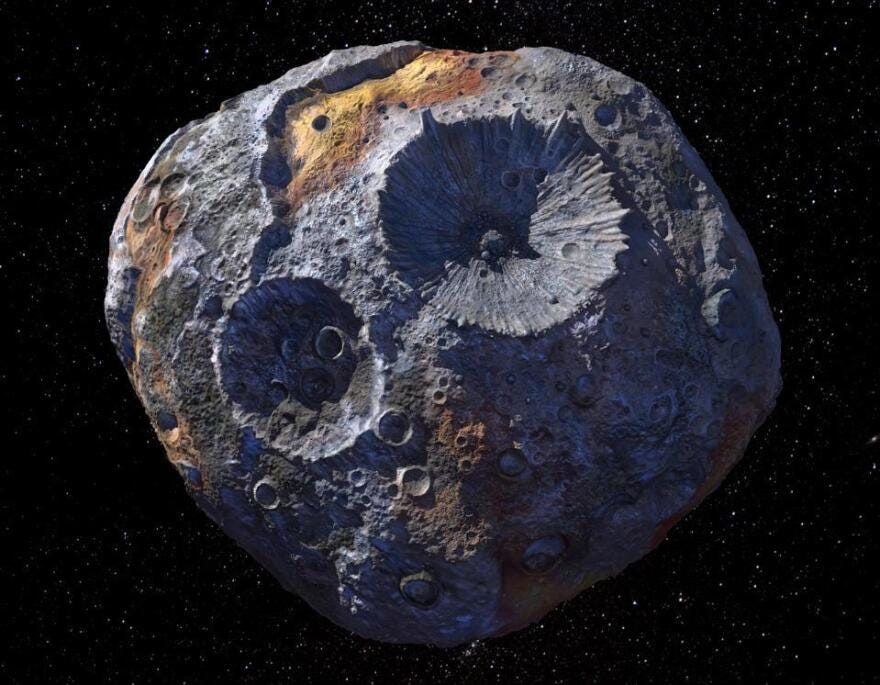
Asteroid Psyche is a giant metal rich asteroid that will be explored by a spacecraft with the same name - NASA's Psyche mission
The timeline: When does the new gold rush begin?
Asteroid mining isn’t just a futuristic fantasy. The process has already begun—at least conceptually and technologically. Scientists, engineers, and policymakers have been discussing the feasibility of asteroid mining for decades, and several private companies have already been founded with the goal of extracting resources from space. Here’s a rough breakdown of when we might see space miners getting their hands (or robotic claws) on some interplanetary treasure:
2025–2035: Scouting missions & tech demonstrations
NASA, ESA, and private firms like SpaceX, Planetary Resources, and AstroForge are working on technology to survey and analyze asteroids. Early robotic prospecting missions will map out valuable celestial bodies and test extraction techniques. NASA’s OSIRIS-REx mission, which successfully returned samples from the asteroid Bennu in 2023, was a major step in demonstrating our ability to interact with these space rocks.2035–2050: First small-scale mining operations
As space travel becomes more routine and cost-efficient, we may see the first actual mining missions. Water-rich asteroids could be the first targets, as extracted water can be converted into rocket fuel, reducing the cost of deep-space missions. Companies like Deep Space Industries have proposed early mining ventures that focus on gathering water from asteroids for use in space stations and refueling stations.2050–2100: Industrialized space mining
If all goes well, by the late 21st century, asteroid mining could be a multi-trillion-dollar industry. Metals like platinum, nickel, and even rare Earth elements (needed for electronics) might be shipped back to Earth or used to construct massive space structures. Long-term missions to mine and refine materials in orbit will likely be fully automated, with AI-driven robotic miners handling the bulk of the work.
The challenges: Why aren’t we mining yet?
Despite the allure of boundless resources, mining in space is no easy task. Here are some of the biggest obstacles:
1. The cost of getting there
Right now, launching anything into space costs thousands of dollars per kilogram. Until reusable rockets and space infrastructure bring costs down, asteroid mining will remain an expensive gamble. However, advancements in rocket technology—such as SpaceX’s Starship—are expected to make deep-space travel far more affordable in the coming decades.
2. Technological hurdles
How do you extract materials in low gravity? How do you refine them? Autonomous robots and AI-driven mining systems will be crucial, but we still have a long way to go in making them reliable. Techniques such as laser ablation, magnetically assisted separation, and in-situ resource utilization (ISRU) are being actively researched to make mining feasible.
3. Legal and ethical quandaries
Who owns an asteroid? The Outer Space Treaty of 1967 prevents nations from claiming celestial bodies, but private companies are in a legal gray area. Future space laws will need to address ownership rights and potential conflicts. The 2015 U.S. Commercial Space Launch Competitiveness Act allows American companies to own and sell resources mined from asteroids, but international agreements will be necessary as space mining becomes a reality.
4. The role of international law and the United Nations
The United Nations has played a crucial role in regulating space activities through treaties and agreements. The Moon Agreement of 1979, although not widely ratified, suggests that space resources should be considered the "common heritage of mankind" and that an international framework should govern their extraction. However, many spacefaring nations, including the U.S. and Russia, have not signed this treaty, leaving asteroid mining laws largely undefined. The UN Office for Outer Space Affairs (UNOOSA) continues to monitor developments and has proposed discussions on how space resources should be governed to prevent conflicts and ensure fair distribution.
5. Market viability
Bringing down tons of platinum might sound lucrative—until you realize that flooding the market could crash prices. Some companies may focus on using asteroid materials in space rather than selling them on Earth. Research papers suggest that in-space manufacturing using asteroid-derived metals could be a more viable business model.
The numbers: How much is an asteroid worth?
Space mining isn’t just theoretical—it’s insanely profitable on paper. Consider these staggering figures:
16 Psyche, a metal-rich asteroid in our solar system, is estimated to contain $10 quintillion worth of nickel and iron. That’s more than the entire global economy—by a lot.
A single 300-meter platinum-rich asteroid could hold $5 trillion worth of platinum, more than all the platinum mined on Earth in history.
Water extracted from asteroids could be sold for $1 million per ton in orbit—cheaper than launching it from Earth.
The asteroid Ryugu, surveyed by Japan’s Hayabusa2 mission, contains carbon-rich material that could provide insight into early solar system chemistry—and potentially offer valuable organic compounds.
The best and worst case scenarios
Best-case scenario:
If asteroid mining succeeds, it could completely revolutionize Earth's economy. Rare metals will become abundant, dramatically lowering the cost of technology and making space colonization a reality. Interplanetary trade could emerge, leading to a new age of economic prosperity. Mining operations in space could reduce the environmental impact of resource extraction on Earth, helping to fight climate change.
Worst-case scenario:
However, the potential for disaster also exists. The massive influx of asteroid-derived materials could destabilize global commodity markets, leading to economic chaos. If only a few companies control asteroid resources, it could result in an unprecedented concentration of wealth and power. There is also the risk of conflicts over asteroid claims, leading to a potential "space gold rush" fraught with geopolitical tensions. Furthermore, a miscalculated attempt to bring a large asteroid closer to Earth for mining purposes could end in catastrophe.
The ecological impact of asteroid mining
While asteroid mining might reduce the need for destructive mining on Earth, it’s not without environmental concerns. The launch and retrieval of asteroid materials will require fuel, which could contribute to pollution. Additionally, if mined materials are returned to Earth, handling and refining them might produce industrial waste. There is also the long-term risk of space debris from failed mining operations, which could threaten satellites and other space infrastructure.
The new space frontier
Asteroid mining is more than a pipe dream—it’s an inevitable step in humanity’s cosmic journey. With ongoing research, technological advancements, and policy developments, the dream of striking it rich among the stars may soon become reality. Whether it leads to untold prosperity or unprecedented economic upheaval depends on how we navigate the challenges ahead. One thing is certain: the gold rush of the 21st century might just be written in the stars.